A grind is a cross-section, not an angle
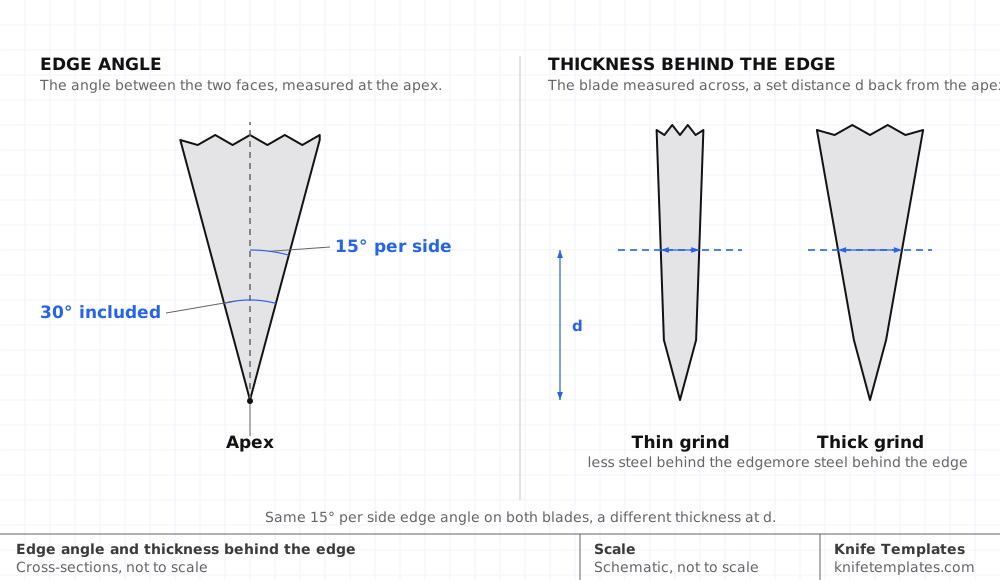
People use "grind" and "edge angle" as if they were the same thing. They are different. The grind is the shape of the blade's cross-section: how the steel tapers from the spine down to the edge. The edge angle is the angle at the very apex, where the two sides meet. A flat-ground knife can be sharpened to many different edge angles, and so can a hollow-ground one.
It helps to be exact about the angle too. Fifteen degrees per side is 30 degrees included. The trade-off is plain: other things equal, the smaller the included angle, the sharper the blade and the more easily its edge is damaged.
The other number that matters is how thick the steel is a little way behind the edge. It is the same trade-off: thinner, sharper, more acute edges are not as strong as heavier edges. A grind is largely a decision about how quickly the steel gets thin, and how thin it is when it gets to the edge.
The grinds you will meet
I have tried to describe each grind by what it looks like, because the names are less consistent than they seem. Where I quote a maker by name below, it is from Blade Magazine's feature on grinds, which asked working makers what they prefer.
Flat grind
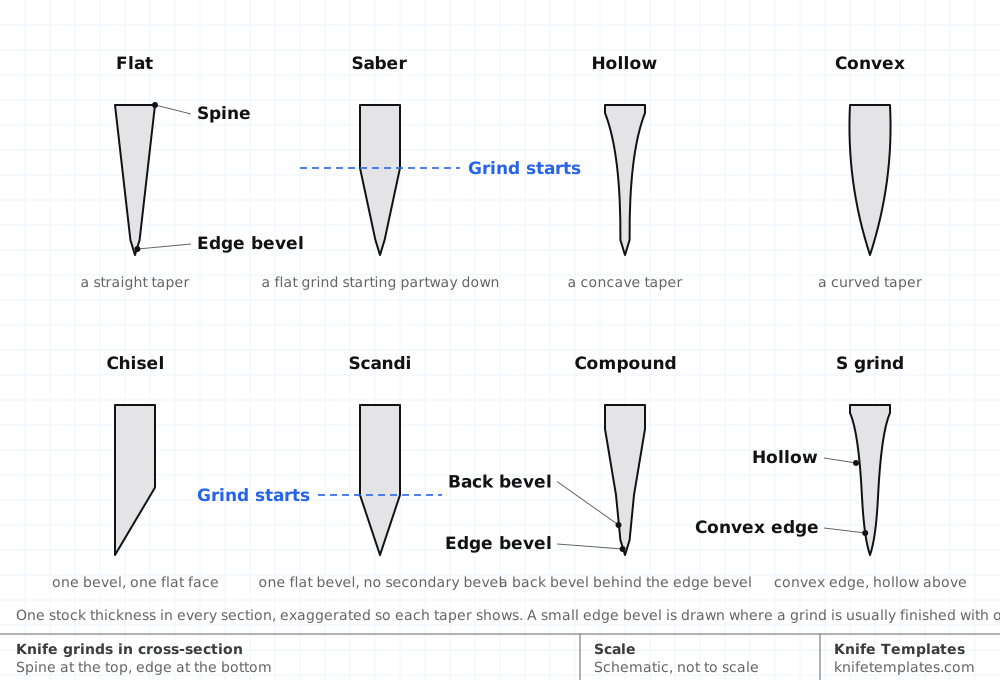
The blade tapers in straight lines from the spine, or from partway down the blade, to the edge. Jim MacNair calls strength and toughness the "most obvious benefit of the flat grind". Others say it trades some edge durability for sharpness. Both can be true, because it depends on how thin you take the edge. A flat grind that finishes thin is a slicer. One that finishes thicker is sturdier.
On a belt grinder, a flat grind is made against a flat platen, one side at a time.
Saber grind
A flat grind that starts partway down the blade instead of at the spine, which leaves more steel along the top. Where exactly it starts depends on who you ask: about the middle of the blade in some sources, about a third of the way down in others. I'd treat it as a range. It is also called a "V grind" and is common on tactical and military knives. Abe Elias says that on small bushcraft knives a thin flat grind or a saber grind are hard to beat.
Hollow grind
Each side is ground concave, usually on a wheel. Jim MacNair says hollow grinds are "great for slicing", because the grind scoops away more steel and leaves the blade thinner behind the edge, and the panel of the grind stays thin as you sharpen the blade away over time. A hollow-ground edge is very sharp and fragile, and it is the grind of straight razors. The thin edge has less steel behind it, which is why hollow grinds are usually described as better for slicing than for hard use.
Both sides can be ground at once on a wheel, which makes this a quick grind to produce. Swapping the flat platen for a wheel is how you move from flat to hollow.
Convex grind
The sides curve outward instead of tapering in straight lines. It keeps a lot of metal behind the edge, which makes for a stronger edge. Jim Crowell grinds a flat taper from the spine and rolls the edge convex just before it, and makes the point that "it's the edge that needs to be convex, not necessarily the whole cross section of the blade." He says convex geometry gives the least resistance when cutting through an object.
The catch is skill. Convex grinds are usually finished by hand, which is why you find them on custom knives, and the grind needs some skill to reproduce on a flat stone.
Scandi grind
A single flat bevel that runs from the shoulder to the edge, with no separate secondary bevel on top. The name is short for Scandinavian, and the Finnish puukko is the classic example. Abe Elias describes it as a "perfectly flat grind with no secondary bevel". It is easier to sharpen because of the large surface.
Makers don't agree on how robust it is. Jim Crowell says that because the grind line is the cutting edge, the edge is more fragile than on other grinds. Abe Elias says it doesn't tend to go through soft materials well, such as meat, and that the angle should be proportional to the thickness of the steel and the knife's design.
Because the whole bevel is the edge bevel, changing the angle later means changing the whole bevel. That is simply how it is built.
Chisel grind
Ground on one side only, with the other side left flat. It is typically ground at about 20 to 30 degrees. Left- and right-handed versions exist. You will also see single bevel edges on Japanese kitchen knives, which sharpen differently from double bevel knives. The kiridashi, a small Japanese utility knife, is a good first project for a chisel grind.
Compound or double bevel
A back bevel is ground behind the edge bevel, so the steel behind the edge is thinner. That improves cutting ability. Jim MacNair uses "compound" for something a little different: a blade that combines hollow and flat bevels, for example a thin hollow edge for slicing with a thicker flat-ground tip for toughness. Some kitchen knife sellers use it as an umbrella for any blade with more than one geometry stacked in a single cross-section, which is where the S grind belongs.
S grind
A convex bevel at the edge with a hollow ground into both faces just above it, so each face has an S-shaped curve. It is mostly a kitchen knife grind. The hollow gives relief above the edge, so food lets go of the blade, and the convex part keeps strength at the edge. Modern Cooking's grind guide calls it the classic food-release grind.
There are variants. A C grind keeps the convex bevel on both faces but puts the hollow on one face only. An S-hook, also called a hook, harpoon or J grind, puts the hollow very close to the edge, which releases food best and, according to the same guide, needs the most maintenance. I could only find the S grind written up properly by kitchen knife sellers, so treat those names as one source's.
Sharpening takes steel from the convex part at the edge, so over many sharpenings the edge works its way up toward the hollow.
Names overlap, so describe the shape
Sources describe the same knife with different words:
- Wikipedia calls Scandi a saber grind without a secondary bevel. Abe Elias describes it as a flat grind with no secondary bevel.
- "Compound" means a back bevel in one source, a hollow-plus-flat blade in another, and any stacked geometry (the S grind included) in a third.
- "Full flat" and "high flat" appear on makers' sites but weren't defined in most of the references I read.
When you talk to a maker or a supplier, say what you mean in measurements: where the grind starts, how thick the steel is behind the edge, and the angle you sharpen to.
A quick comparison
| Grind | Cross-section | What it's good at | Watch for |
|---|---|---|---|
| Flat | Straight taper | Strength and toughness (MacNair) | Edge durability depends on how thin you finish it |
| Saber | Flat grind starting partway down | Extra steel along the top; popular on small bushcraft knives (Elias) | Where it starts is not standardised |
| Hollow | Concave taper | Slicing, and stays thin as you sharpen (MacNair) | A thin edge is fragile |
| Convex | Curved taper | A strong edge with little resistance in the cut (Crowell) | Hard to do well, often hand-finished |
| Scandi | One flat bevel to the edge | Easier to sharpen thanks to the large flat surface | Cutting soft materials (Elias); edge may be more fragile (Crowell) |
| Chisel | One bevel, one flat side | Single bevel tools such as the kiridashi, and some Japanese kitchen knives | Left- and right-handed versions, different sharpening |
| S grind | Convex at the edge, hollow just above | Relief above the edge so food releases, strength at the edge (Modern Cooking) | Sharpening works the edge up toward the hollow |
Choosing for the knife you are making
I would work backwards from three questions.
- What will it cut? A kitchen knife is mostly slicing food, so thin geometry earns its keep. A knife that chops, pries or gets knocked around leans on the steel behind the edge. If food sticking to the blade is what bothers you, that is what the S grind is for.
- How thick is the stock? The same grind looks very different on thin and thick bar, and thicker bar leaves you more steel to remove.
- How will you grind it? A flat platen makes flat grinds easily. A wheel makes hollow grinds. Convex wants practice. The grind you can make evenly beats the one that sounds best.
Whatever you choose, the steel also has to cope with it. Thin, acute edges roll or chip if the steel is too soft or too brittle, so hardness and carbide structure both matter. My guide to Rockwell hardness covers the hardness side.
What the editor draws
The editor draws a bevel line and a plunge line on its templates. They are layout lines, and they don't choose a cross-section for you. The bevel line marks how far up the blade the grind climbs (it is set as a percentage of the heel height), and the plunge line marks where the grind stops near the handle (it is a distance forward from the heel). Use them as layout lines when you mark the steel, then pick the grind you want.
Where this comes from
Blade Magazine's feature on blade grinds (Abe Elias, Jim Crowell, Jim MacNair and others), Wikipedia's article on grinds, Larrin Thomas's article on edge stability at Knife Steel Nerds, Modern Cooking's grind guide for the S grind and its variants, and Tharwa Valley Forge's push stick grinding tutorial. If your experience of a grind is different from what is written here, add a comment. Grind names are argued about, and I would rather learn from it.
Comments
Questions, corrections and what worked for you. Upvote comments you find useful.
Loading comments…