Why the names matter
Knifemakers use a shared vocabulary, but not a perfectly shared one. Western makers, Japanese kitchen knife makers and sword makers all use some of the same words for slightly different things. That is fine when you are reading, and frustrating when you are about to order steel or describe a change to someone.
I use the terms below the way the templates and the editor use them, and I flag the places where the sources disagree. When it matters, I'd always follow a word with a measurement.
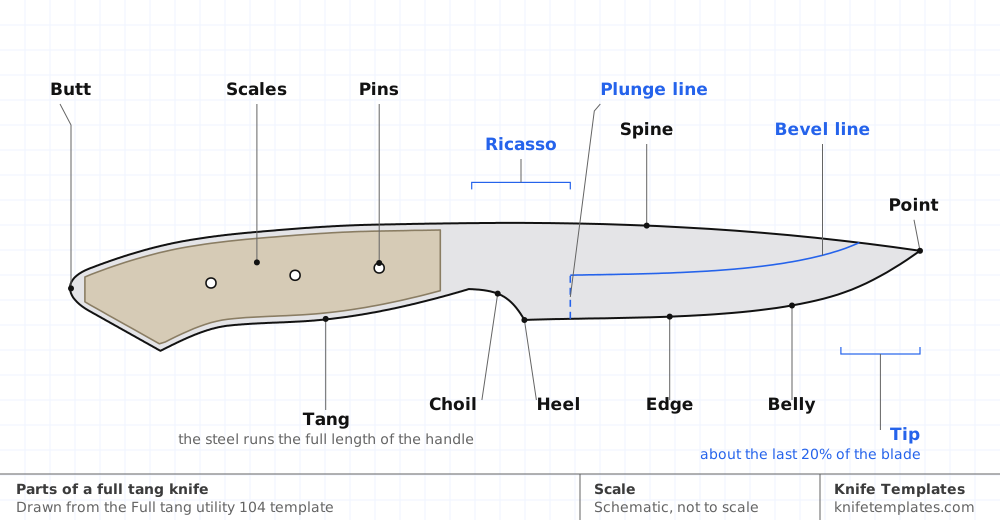
The cutting side
Edge. The (usually) sharpened part of the blade, running from the point to the heel, furthest from the spine.
Point and tip. The point is where the edge and the spine meet, and it is the sharp end used for piercing. Some makers separate the two: the tip is the forwardmost section of the blade, roughly the last 20% of its length, and it includes the point. Plenty of people say "tip" for both, so don't be surprised.
Belly. The curve of the edge as it sweeps up toward the point. More curve means more belly. In the editor, tip rise is how far the tip sits above the heel edge datum, and more rise creates more belly near the tip.
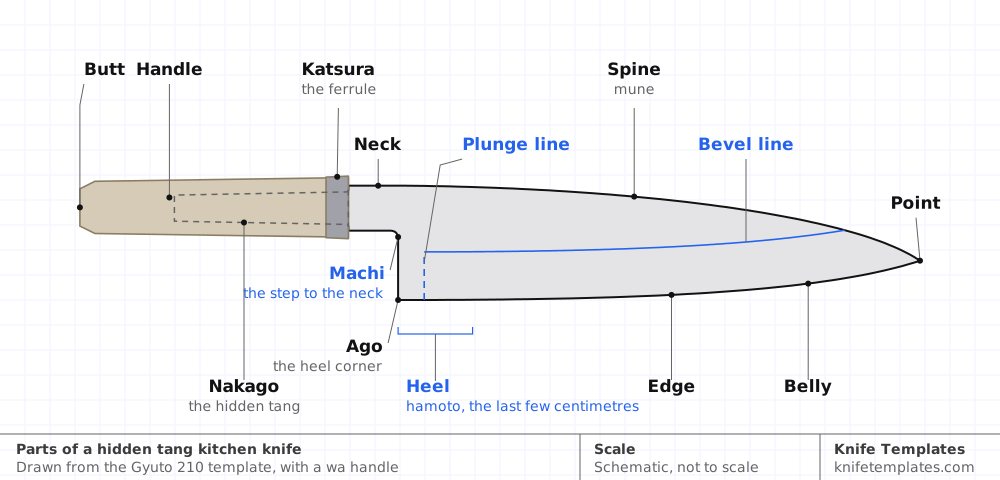
Heel. The rear part of the edge, closest to the handle. A knife has a heel when the edge curves down and away from the handle. It is often rounded off or left wide so it is comfortable in a pinch grip, and Japanese blades often have a prominent one. The Japanese term, hamoto, means the last few centimetres of the edge next to the handle. In the editor, heel height is the vertical height of the blade at the heel, measured from the edge datum to the spine.
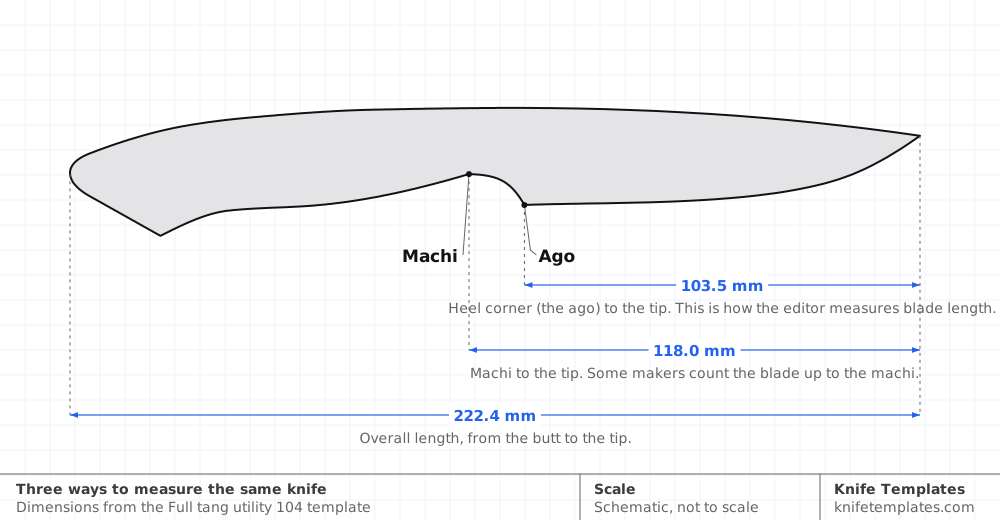
Ago. The Japanese word for chin, used for the corner of the blade heel. The editor's blade length is measured from this heel corner, or ago, to the tip.
Japanese kitchen knives have a few terms of their own, and a hidden tang changes what you can see. This is the same set of ideas on a gyuto with a wa handle.
The back and the grind
Spine. The part of the blade furthest from the edge. On a single-edged knife it is the side opposite the edge. It is the thickest part of the blade. Japanese makers call it the mune.
Plunge line. The line where the grind stops and the flat of the blade carries on toward the handle. In the editor, the plunge guide is set as a distance forward from the heel. My guide to knife grinds covers the grinds that end at it.
Fuller. A groove in the flat of the blade, usually added to make it lighter. Some say a forged fuller can also strengthen the blade, though that claim is disputed, and others call fullers mostly decorative, though they can lighten or balance a blade.
Where the blade meets the handle
This is the part where the words get slippery.
Ricasso. The unsharpened length of blade just before the guard or handle. It creates a transition between the sharp edge and the handle, strengthens the blade at the point where the tang meets the edge, and is a convenient place for a maker's mark. Some references put it at the junction of the blade and the bolster or guard.
Choil. There are two meanings. A finger choil is a large unsharpened section at the ricasso, curved to take the index finger. A sharpening choil is a small notch or relief at the end of the edge next to the ricasso, which lets you sharpen all the way to the heel. Some definitions cover both ideas: an unsharpened, hollowed space at the bottom of the edge near the handle, which lets you sharpen the whole edge and can give room for a finger.
In the editor, the choil is the curve running from the heel up to the machi. The choil presets reshape that curve, and the heel corner radius is what a pinch grip rests against.
Machi. A word from Japanese knives: a short section of metal at the end of the blade's neck, found on many Japanese knives and never on Western ones. The idea I find useful when making is the step where the blade narrows into the tang, and the editor uses the word that way. In the editor, machi height is the height of that step on the underside of the knife, and "Machi from the heel" sets where it sits along the knife. A handle style attaches at two anchors: the heel height on the top edge, and the machi height on the underside.
Tang. The part of the blade that extends into the handle. A full tang runs most or all of the way through the grip. In Japanese, the tang is the nakago, the part of the metal to which the handle is attached. For a closer look at the two main constructions, see my guide to full tang and hidden tang knives.
The handle
Bolster. A piece of heavy material, usually metal, at the front or rear of the handle, or a thickened section of the blade that flows into it. It reinforces the junction between blade and handle, one of the weakest areas, and can be decorative as well as functional.
Guard. The barrier between the blade and the handle that stops your hand sliding forward onto the edge. Many kitchen knives don't have one.
Scales. The two slabs of handle material fastened to either side of a full tang, usually with pins and epoxy.
Ferrule. A collar at the front of a hidden tang handle. On Japanese handles it is usually called a katsura. Kakumaki is also used, but not often.
Butt or pommel. The end of the handle. "Butt" is the more correct term for the bottom of the handle. A pommel is a weighted cap, which few knives have today.
Jimping. Grooves or notches cut into the spine for grip. It is most common on pocketknives and hard-use fixed blades, near the handle.
Where sources disagree
- Point or tip. Some separate them, as above. Others use one word.
- Handle or hilt. There is not really much technical difference. "Hilt" tends to be used for longer blades.
- Butt or pommel. Both are used for the end of the handle, though "butt" is considered more correct.
- Bolster and guard. They overlap. A definition of the ricasso may name the "bolster or guard" as one junction, and a front bolster can do the guard's job.
- Choil. As above, it is either a finger notch or a sharpening notch.
- Heel. It is the rear part of the edge in most sources, but not every source defines it, and the same word is used for the corner, the rear of the blade, and the last few centimetres of the edge.
Measuring a blade
This is where vocabulary costs money. For Japanese knives with a machi, the specified blade length includes all of the blade up to the machi notch, though some makers don't include the machi in blade length at all. If you are unsure, ask. The editor measures blade length horizontally from the heel corner (the ago) to the tip, and calls it the working blade length. If you are comparing a template with a knife you own, measure both the same way. You can compare templates side by side at the same scale.
Finding these parts in the editor
Open a template in the editor and you will see handles for the heel height, the heel position, the machi height, the plunge line and the choil. Dragging one changes that dimension, and the hints in the panel explain what each one does. The editing guide covers how to use them, and the print guide covers getting the printed dimensions right.
Where this comes from
Blade Magazine's crash course in knife anatomy, Wikipedia's article on the knife, Tharwa Valley Forge's article on the ricasso, the Blade Reviews knife dictionary and Zknives' Japanese kitchen knife terminology. If a word on your bench means something different, add a comment. These terms are still argued about, and I'd like to cover the regional ones properly.
Comments
Questions, corrections and what worked for you. Upvote comments you find useful.
Loading comments…